
Introducing Nymrio: A foundation for deterministic agentic workflows
Move past fragile prompt chains. Nymrio gives teams the primitives to design, inspect, and deploy multi-agent systems with granular control.
By Nymrio Team
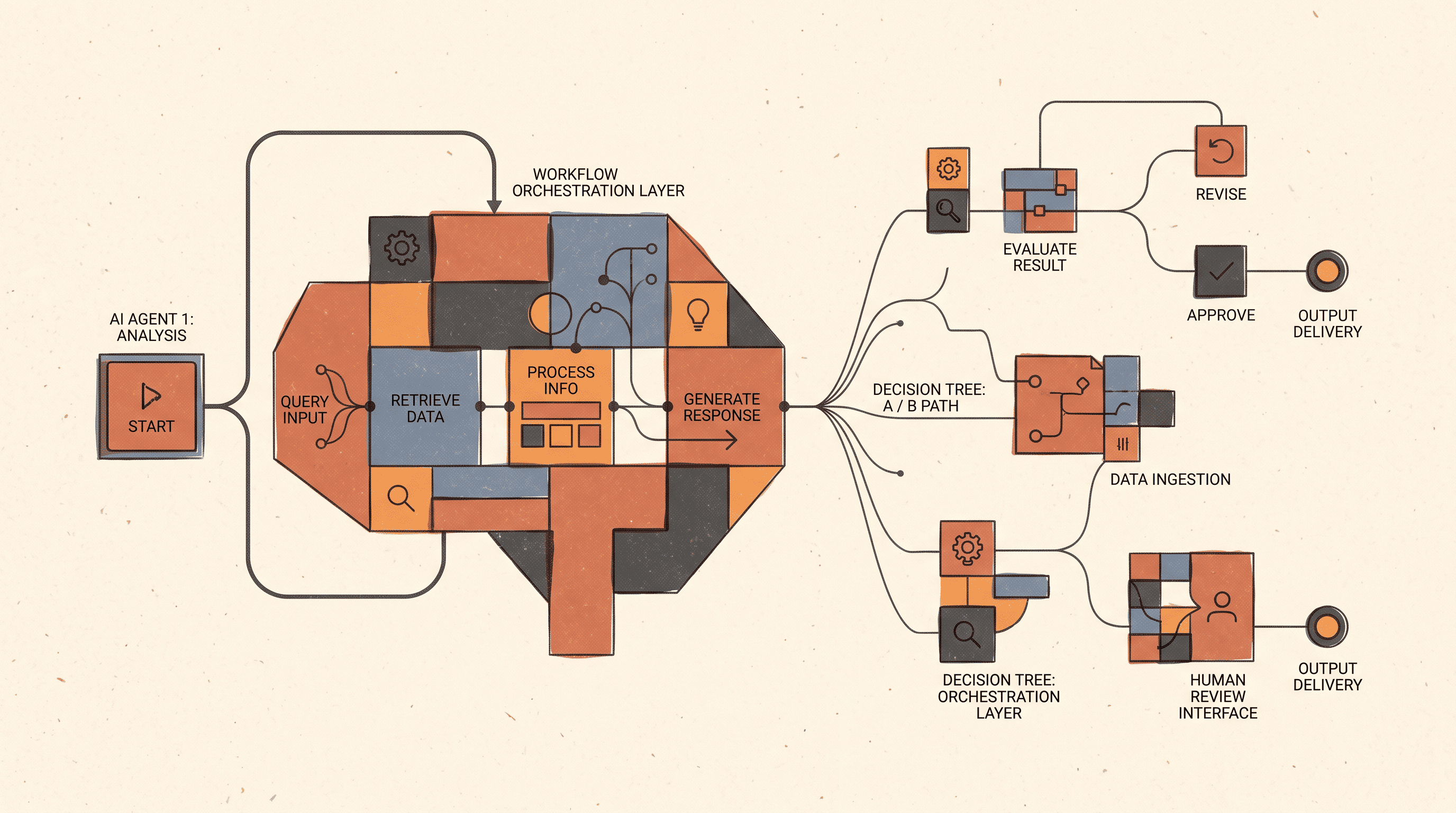
Most AI applications begin as single prompt calls. As requirements grow, teams string together multi-turn conversations, external API calls, and retrieval steps into linear pipelines.
Eventually, these pipelines reach an architectural ceiling. Real-world tasks are rarely linear: they require dynamic branching, self-correction, parallel exploration, and bounded autonomy. But unrestrained autonomy without architectural boundaries quickly leads to hallucination loops, non-deterministic errors, and unmaintainable code.
Today, we are launching Nymrio — a platform engineered to build, orchestrate, and observe autonomous AI agents and resilient agentic workflows.
The failure modes of monolithic agents
When an autonomous agent fails in production, the root cause is rarely the underlying foundation model. It is almost always an architectural breakdown:
- Context pollution: Cramming tool definitions, memory, history, and domain policies into a single context window degrades reasoning quality.
- Unbounded loops: An agent given an open-ended goal can cycle through redundant tool calls without reaching convergence.
- Black-box execution: When an agent acts as an opaque agentic loop, engineers cannot inspect intermediate decisions, pause for human approval, or replay execution paths.
Nymrio treats agent orchestration not as an unpredictable conversation, but as a formal state machine with defined transitions, typed inputs, and explicit constraints.
Modular agents over all-in-one prompts
Rather than building a single generalist agent, resilient systems decompose complex problems into specialized, small agents that collaborate through structured handoffs.
In Nymrio, each agent is defined by four core components:
- Scope and Instructions: Narrow system directives focused on a single domain (e.g., query synthesis, code verification, or policy evaluation).
- Tools and Capabilities: Explicit APIs and data connectors exposed with strictly typed input/output contracts.
- Working Memory: Isolated short-term state that prevents irrelevant chatter from diluting the model's attention.
- Deterministic Guardrails: Hard rules that prevent actions outside designated safety and operational thresholds.
By keeping agents small and specialized, reasoning fidelity stays high and debugging remains tractable.
Composing workflows as state graphs
Agents do not exist in isolation. They need coordination patterns that match the structure of the task.
Nymrio provides visual and programmatic primitives to orchestrate agent networks across three fundamental topologies:
- Supervisory Hierarchies: A coordinator agent analyzes incoming requests, decomposes the plan, routes subtasks to worker agents, and synthesizes the final output.
- Sequential Verification: A generator agent creates candidates (such as database queries or document drafts) while an independent critic agent tests them against test suites or factual constraints.
- Human-in-the-Loop Checkpoints: High-stakes operations—such as database writes, external emails, or financial transactions—can pause execution, notify human operators, and resume seamlessly upon approval.
Every edge in an Nymrio workflow supports conditional routing, retries with exponential backoff, and fallback paths when an agent fails to converge.
Observability and step-by-step replay
Reliability in production requires deep inspectability. Nymrio records every step of an agent’s execution:
- Execution Graph Tracing: See the exact path a run took, which agents were activated, and what tokens or API calls were consumed.
- State Diffing: Inspect the state of the system before and after each agent step to pinpoint where drift or hallucination was introduced.
- Interactive Replay: Fork an execution from any prior checkpoint, modify the instructions or tool response, and re-run to verify fixes instantly.
Start building with Nymrio
Agentic systems represent the transition of AI from passive text generators into active problem solvers. However, their value in production depends on predictability, modularity, and engineering rigor.
Nymrio is now live. Whether you are building automated research assistants, internal operations bots, or customer-facing workflows, we invite you to build with us.